Chrome & Edge extension
Find WCAG 2.2 problems in DevTools — and the ones no scanner can find.
Runs in DevTools against the page you are actually looking at. Every finding points at the element, explains what a real user would experience, and gives you a fix you can paste. Then it walks you through the 18 checks no scanner can answer.
- 18guided manual checks
- 12conformance targets
- 25pages per site scan
- 0network requests to us
How it works
-
1. Install and open DevTools
Load the extension, press F12 on any page, and pick the Accessibility tab. There is no account to create and nothing to configure first.
-
2. Scan the page you are on
One button. Findings appear with the element highlighted in the page, the measured evidence, and a fix you can paste.
-
3. Do the part automation cannot
Work through the 18 guided checks, record what you found, and export the whole thing — machine results and human judgement in one report.
What it will not do
Automated rules find a meaningful subset of WCAG failures — commonly cited as between a third and a half. No scanner establishes conformance on its own, and one that tells you it has is setting you up for a complaint you cannot answer.
That is the reason the guided checks exist, and the reason a completed review is recorded as human judgement rather than added to a score.
Everything it does
-
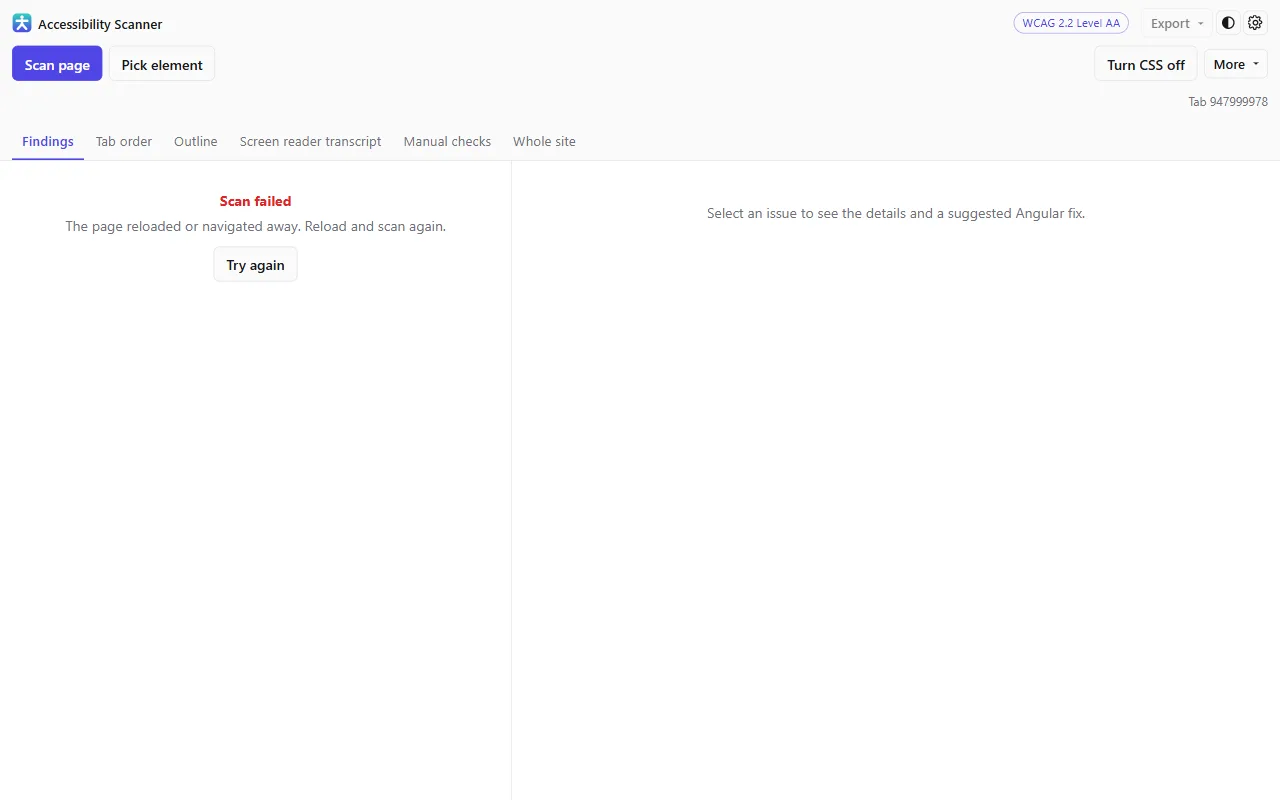
Automated findings
The full axe-core rule set plus checks of our own, run against the page you are actually looking at — including inside iframes and shadow DOM.
Read about automated findings -
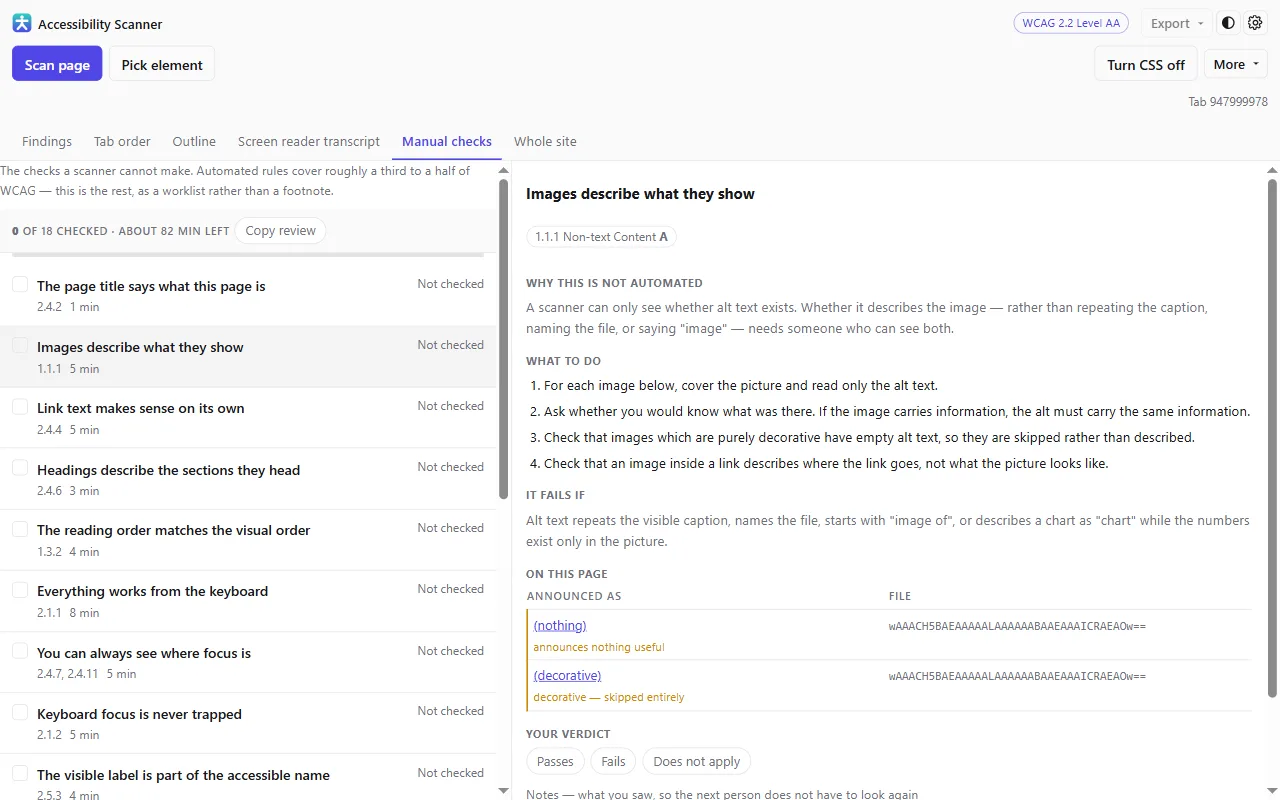
Guided manual checks
Eighteen checks covering what a machine cannot decide, each one gathering the page’s own content so you are reading evidence rather than a reminder.
Read about guided manual checks -
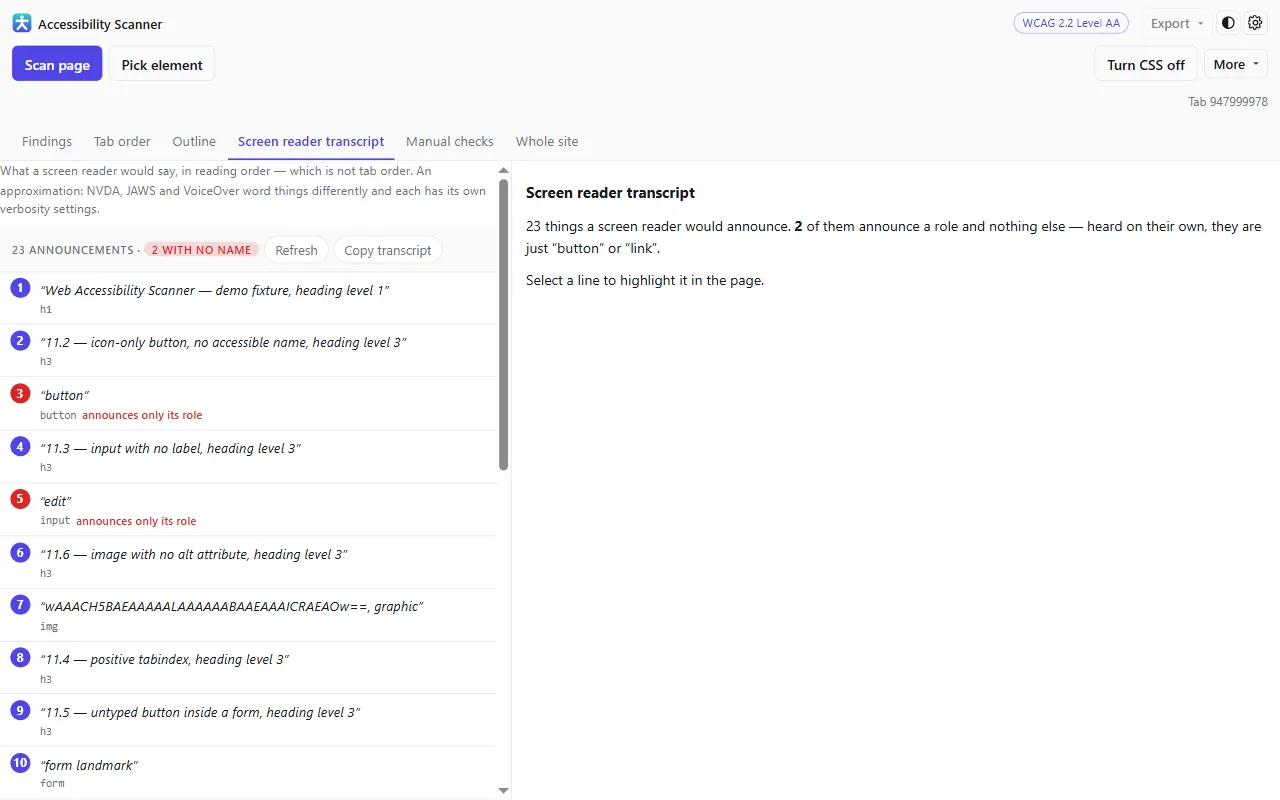
Screen reader transcript
What would actually be announced, in reading order — so an icon button with no label stops looking fine.
Read about screen reader transcript -
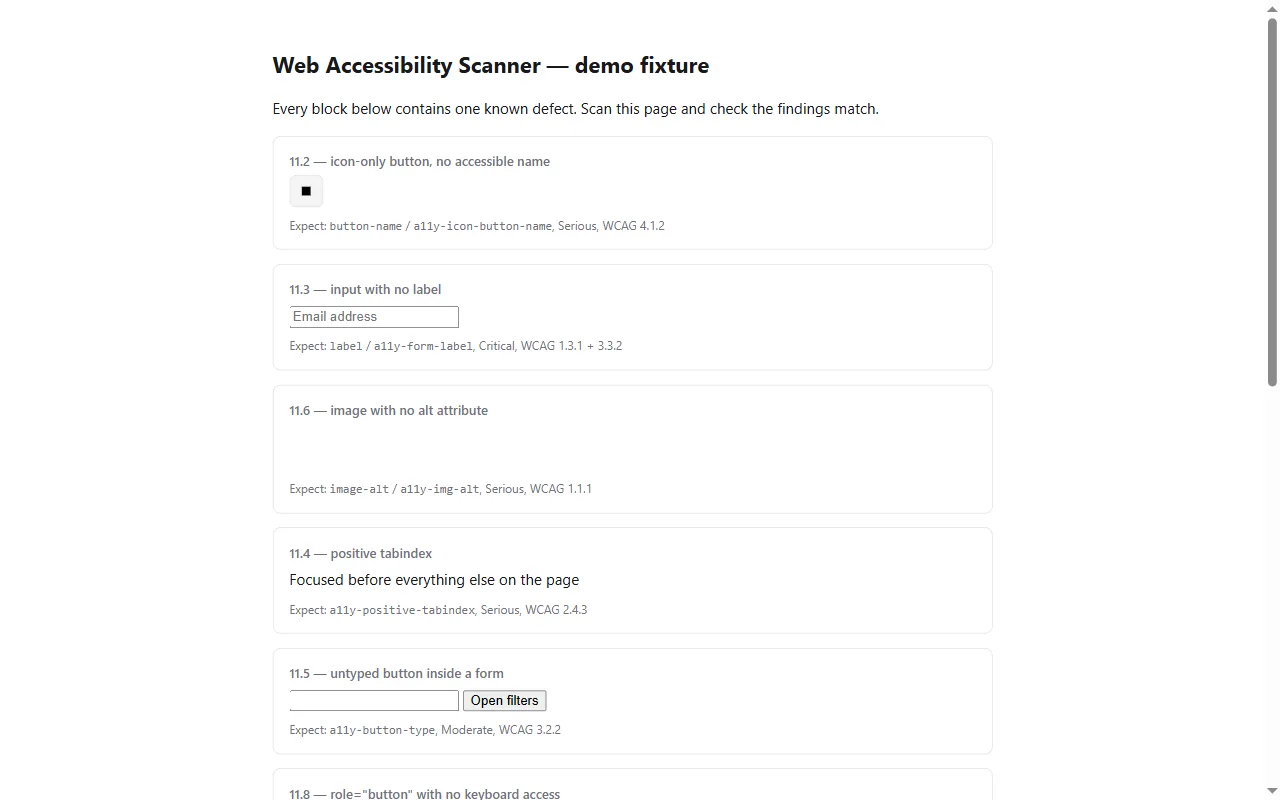
Tab order overlay
The keyboard path drawn and numbered over the page, with a list you can step through.
Read about tab order overlay -
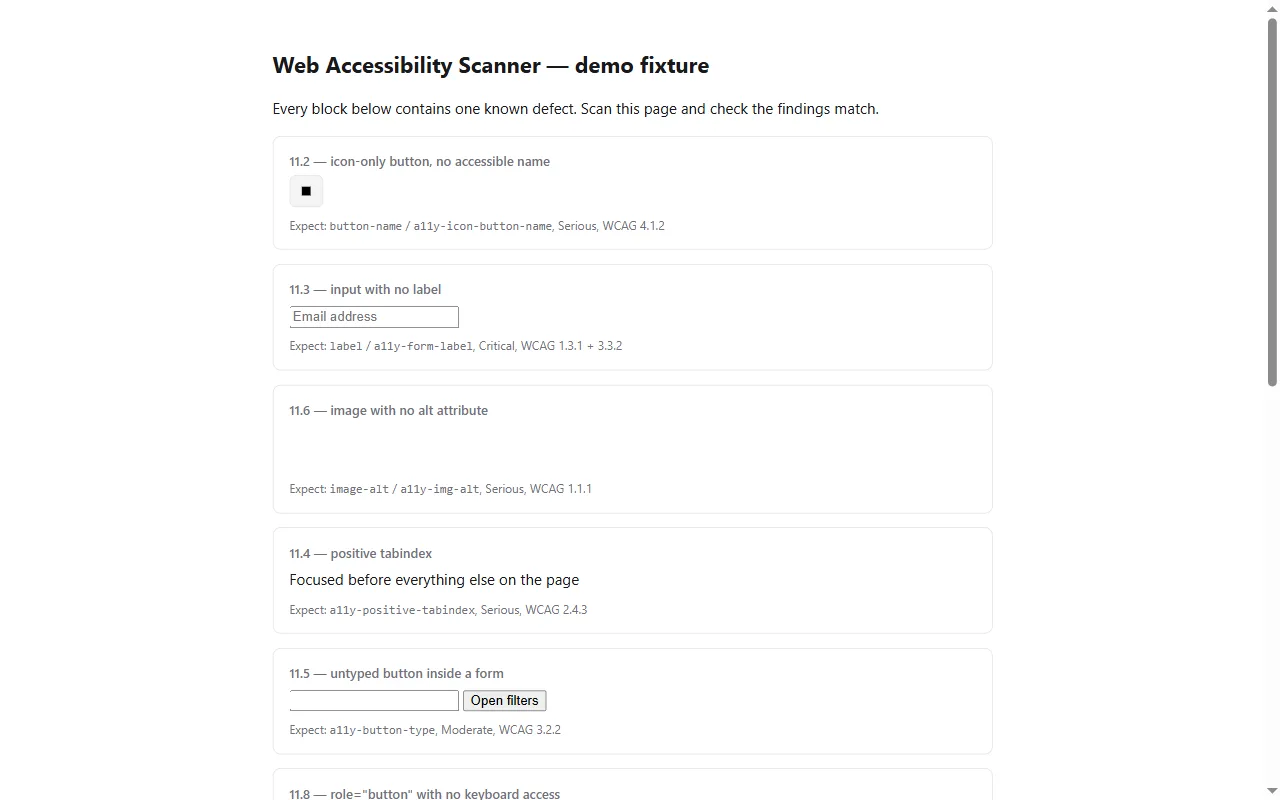
Document outline
Headings and landmarks drawn over the page, so a wall of unlabelled divs is obvious.
Read about document outline -
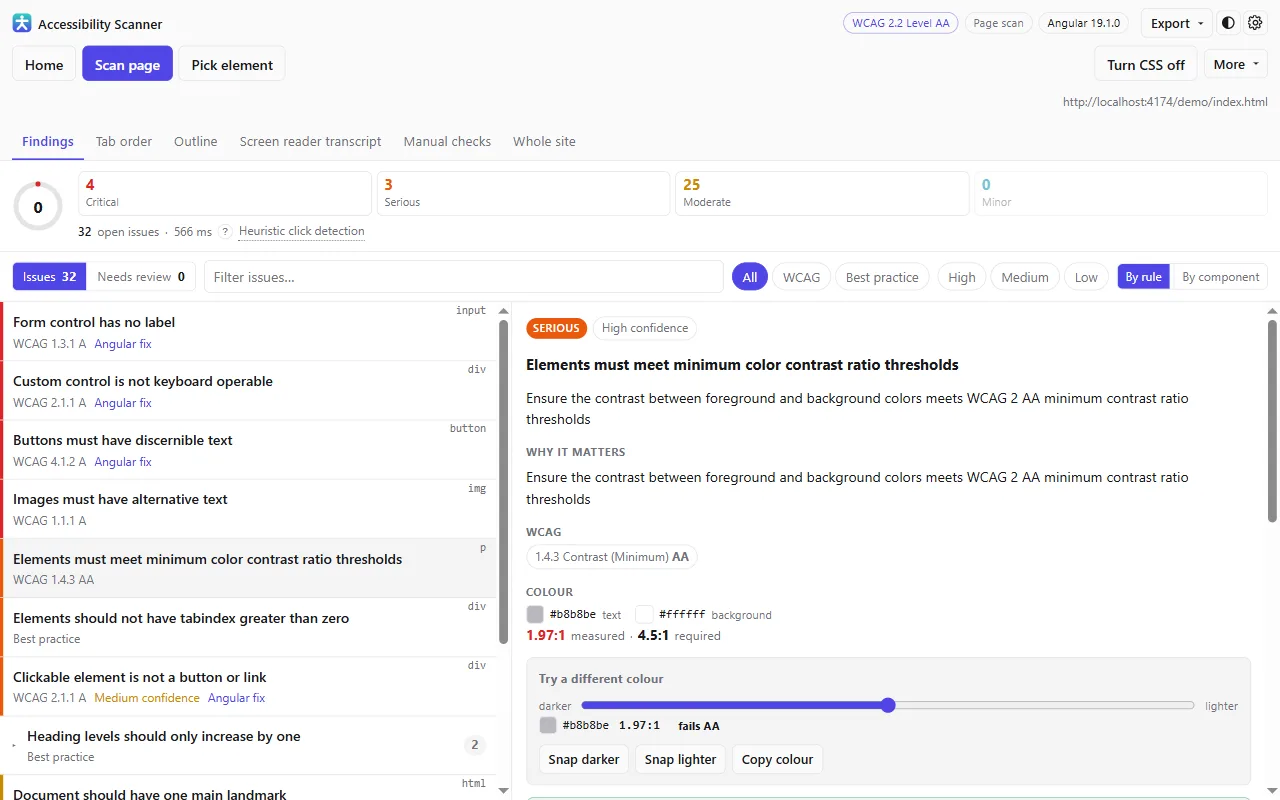
Colour contrast tuner
The measured ratio, the nearest passing colour, and a slider for trying shades until one passes.
Read about colour contrast tuner -
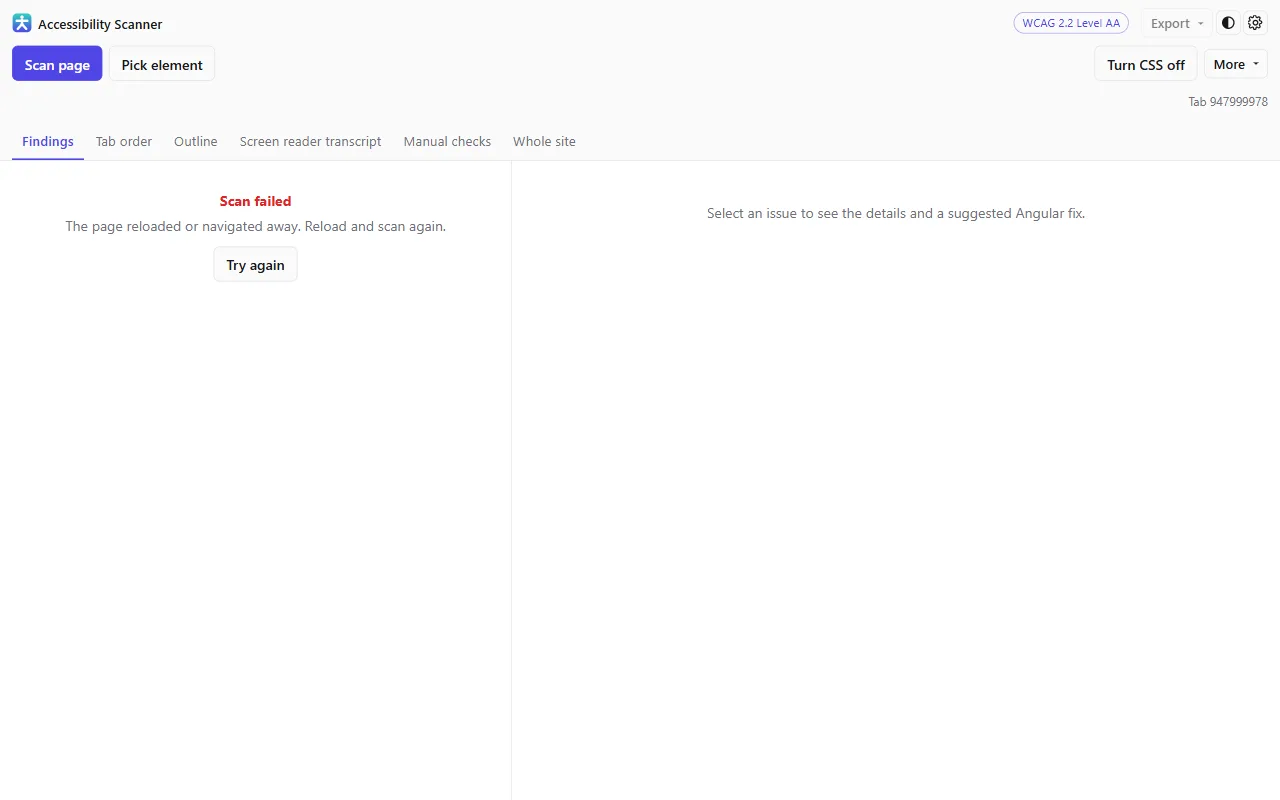
Group by component
Eighty contrast failures are usually one button used eighty times. Fix it once.
Read about group by component -
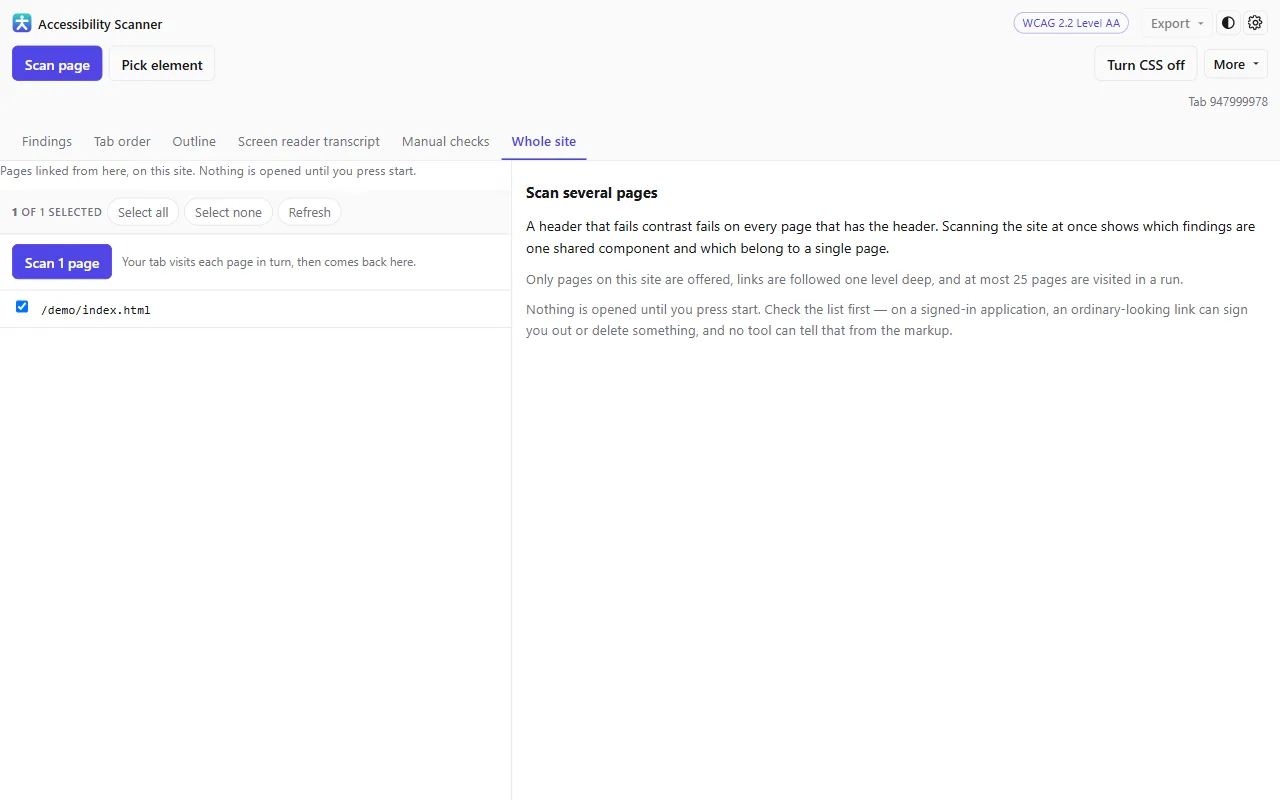
Whole-site scan
Scan up to twenty-five pages of a site in one run and see which findings are shared.
Read about whole-site scan -
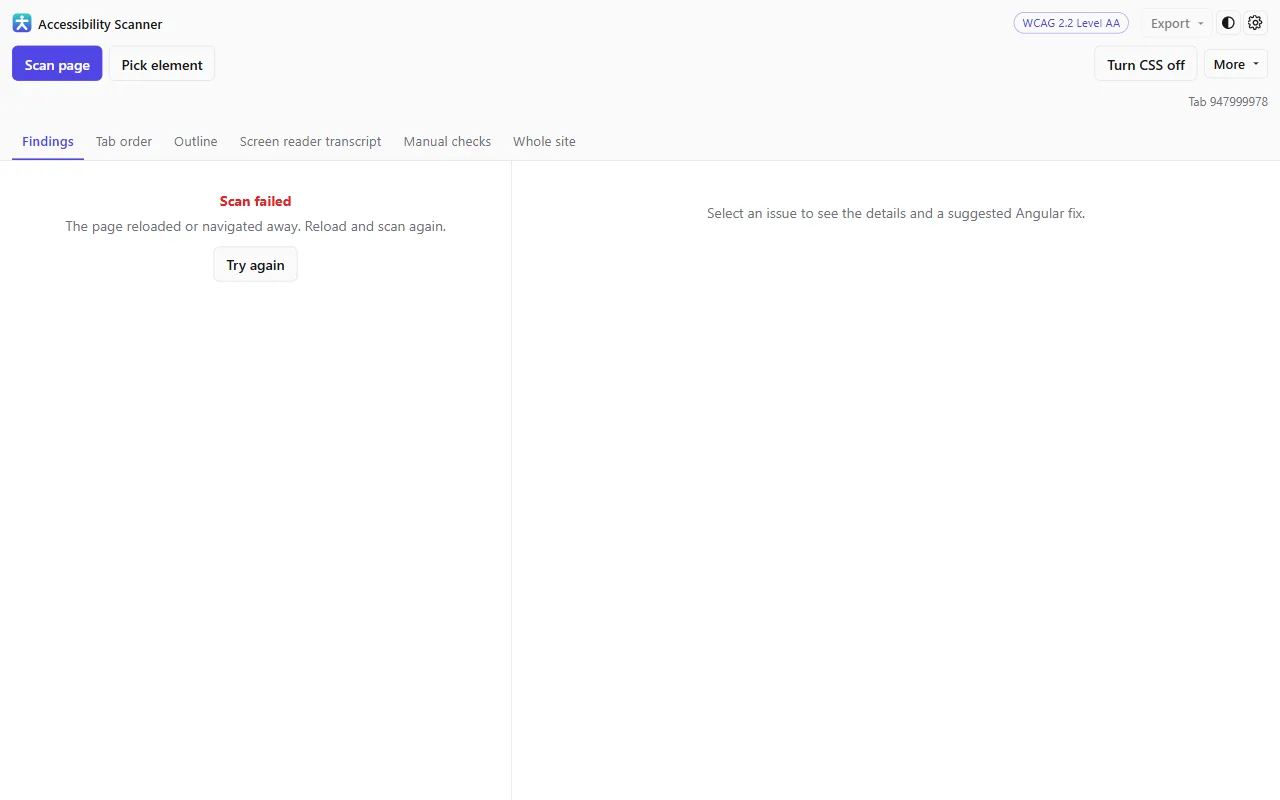
User flows
Record a journey once, replay it whenever you like, and get every state scanned and merged into one report.
Read about user flows -
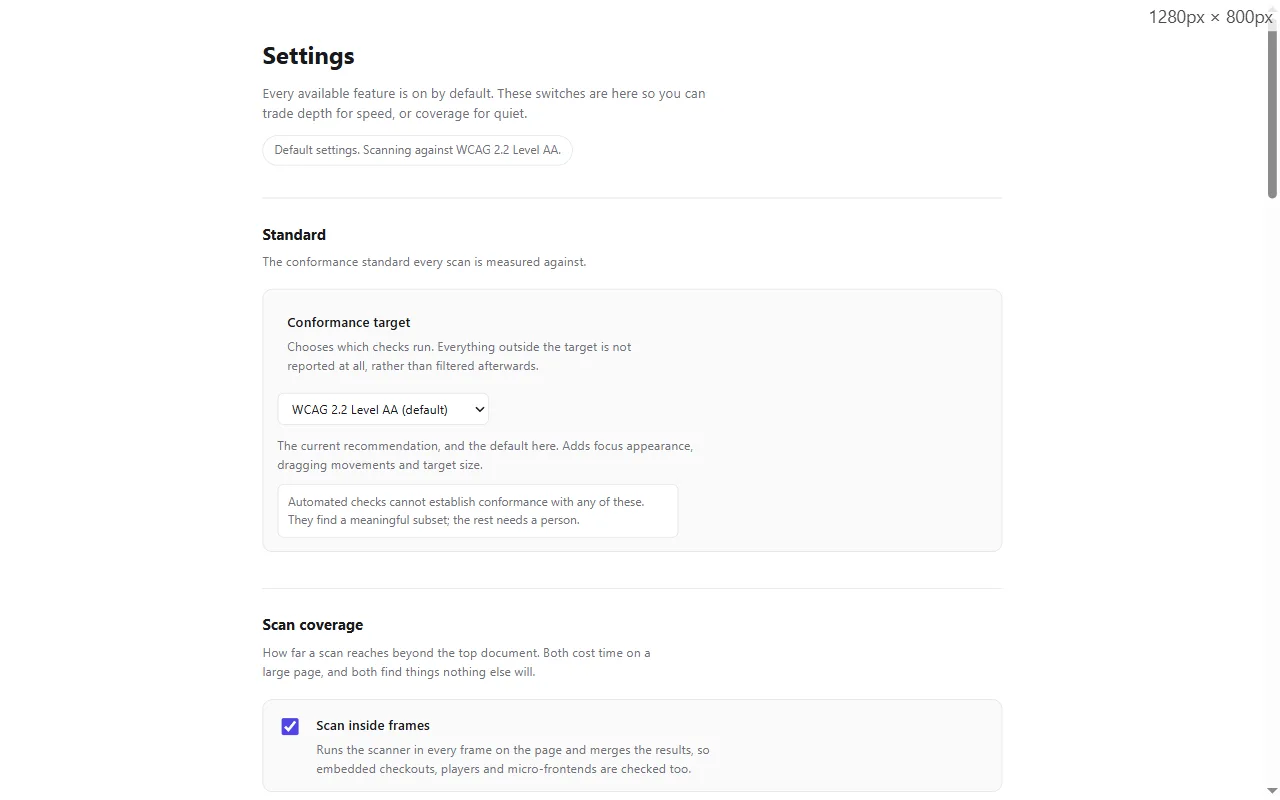
Standards
WCAG 2.0, 2.1 and 2.2, plus Section 508, EN 301 549, Trusted Tester v5 and RGAA 4.
Read about standards -
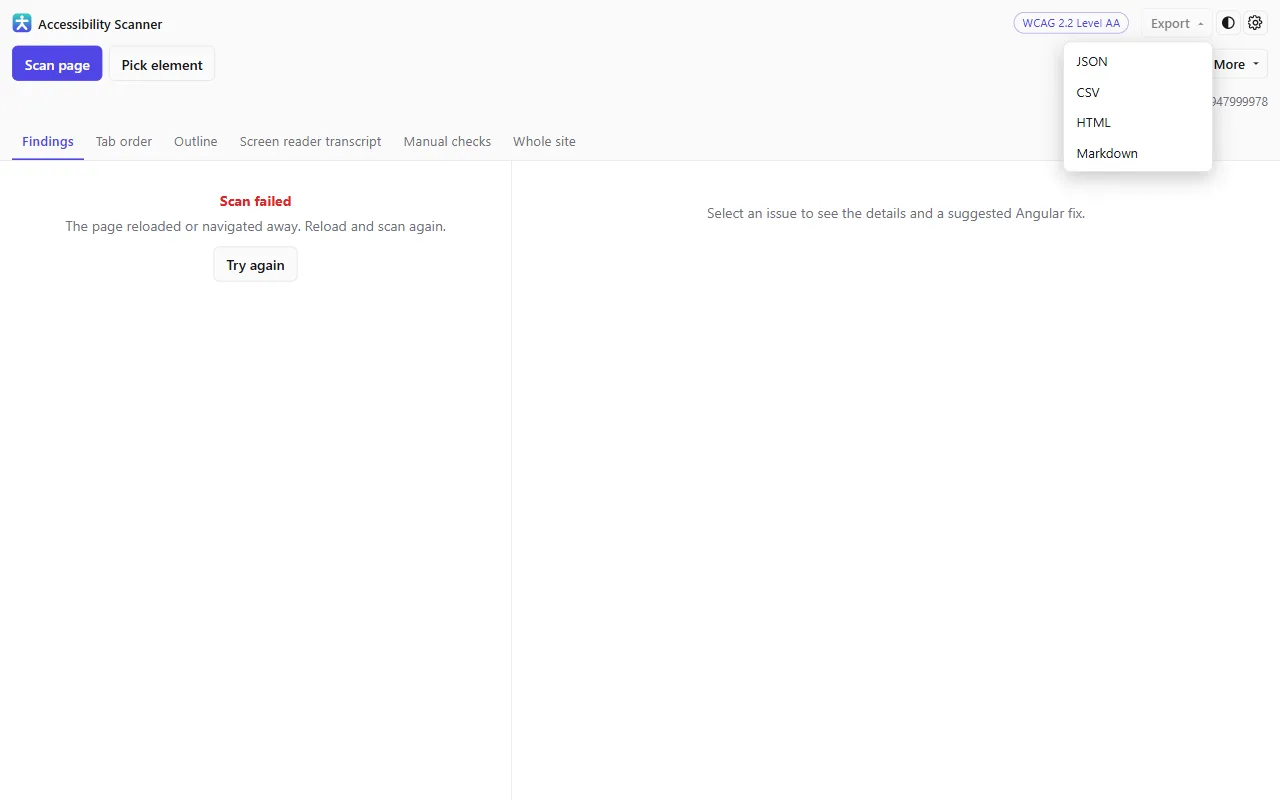
Reports and export
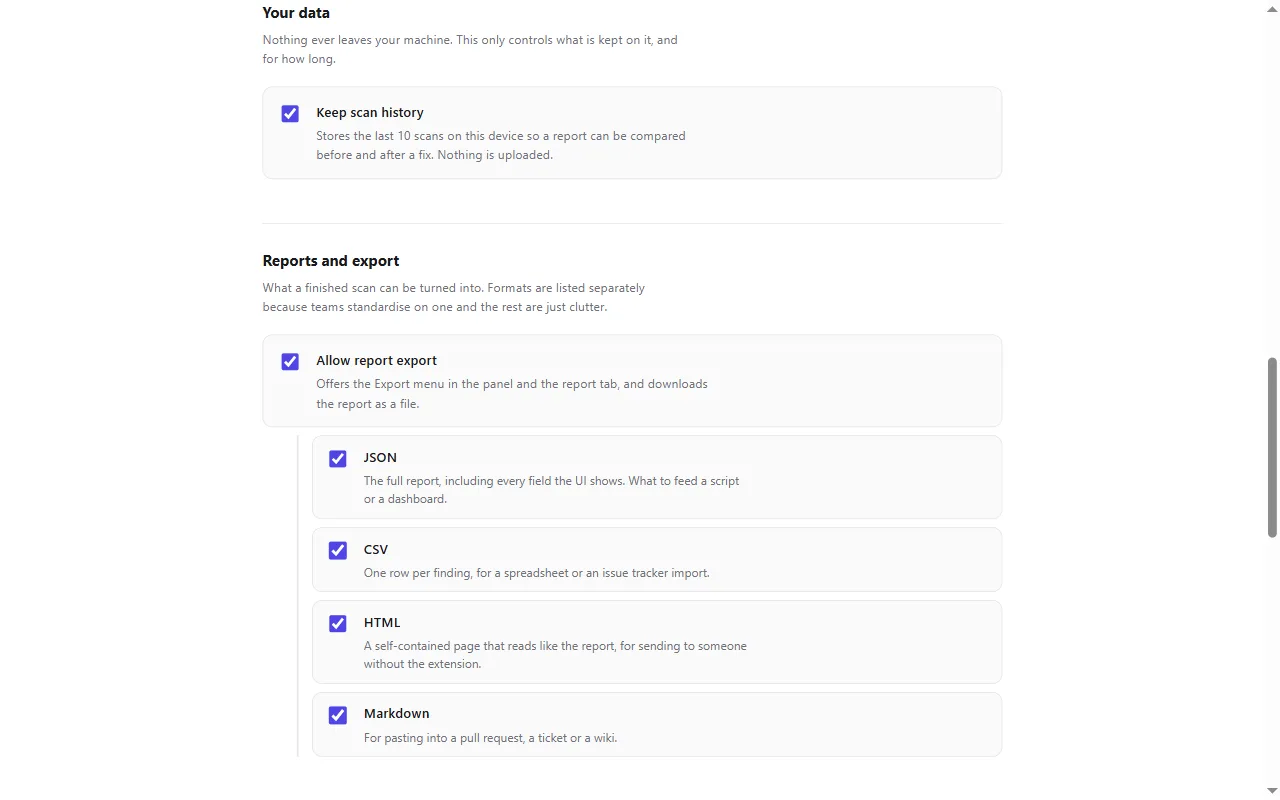
JSON, CSV, HTML or Markdown, with your manual review included — and the last ten scans kept locally.
Read about reports and export -
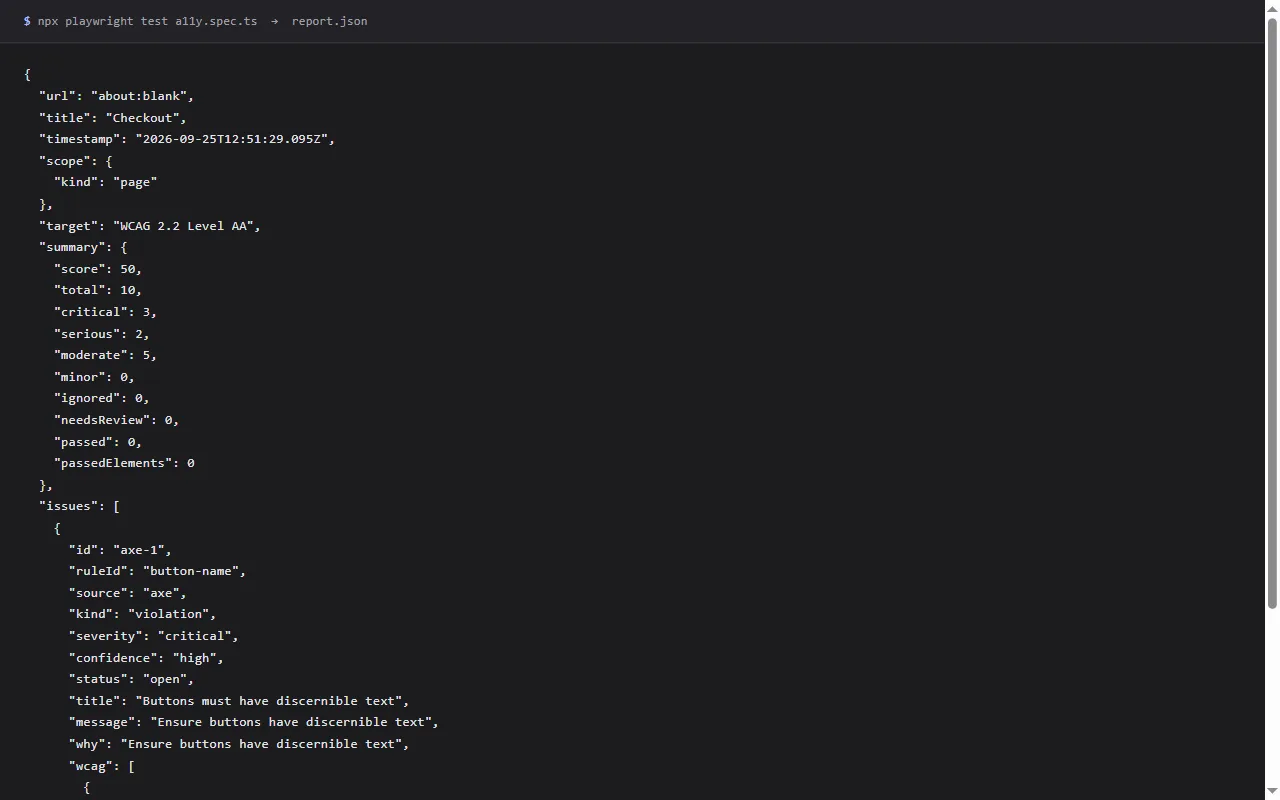
In your pipeline
The same engine as a single file with no browser APIs — inject it with Playwright and assert on the results.
Read about in your pipeline -
Privacy by design
No accounts, no servers, no analytics. Nothing you scan is sent anywhere.
Read about privacy by design
Questions
Does this make my site compliant?
No tool can do that, and you should be wary of any that says otherwise. Automated rules catch a meaningful subset of WCAG failures — commonly cited as a third to a half. The guided manual checks exist to cover the rest, and a completed review is recorded as human judgement rather than folded into a score.
Which browsers does it work in?
Chrome and Edge, as a Manifest V3 extension. It runs as a DevTools panel, and also as a detached window if you would rather keep DevTools for something else.
Does it work with my framework?
Every check runs on plain DOM, so React, Angular, Vue, Svelte, Rails, WordPress and hand-written HTML are all scanned identically. When a framework is recognised you additionally get the fix written in its idiom. Detection changes the suggestions, never the findings.
Does anything I scan get sent anywhere?
No. There is no backend, no analytics and no third-party SDKs. Some things are stored on your own device so they survive a restart — settings, recent scans, recorded flows, manual review notes — and each can be deleted.
What does it cost?
Every feature is free in the current release. Some are marked PRO: the licensing machinery is built and nothing is withheld, so those badges are a statement of intent rather than a gate.
Can I run it in CI?
Yes. The same engine ships as a single file with no browser APIs, so any runner that can inject a script can produce the same report as JSON.